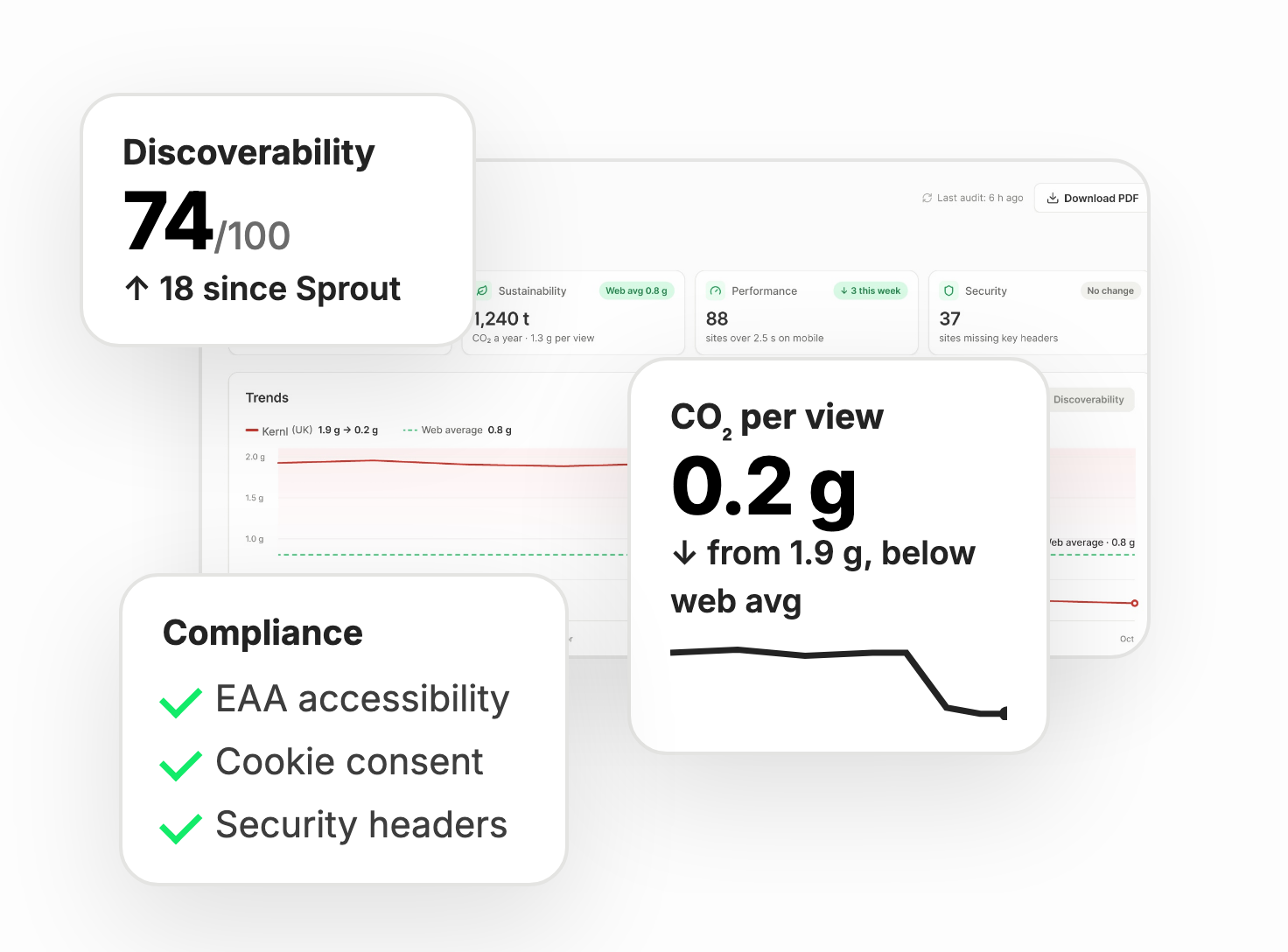
Every company website is now regulated. Sprout finds every one, fixes it and keeps it compliant.
AI builds websites ten times faster, but nobody guarantees what comes out. Sprout does: new sites are compliant by default, and every site a company already owns sits in one panel, checked and fixed.
ClimateAccessibilityCybersecurityCookies and privacyAI reach
Put companies back in control of every website they own.
Vision
A web where every website is secure, discoverable, sustainable and accessible to everyone.
Mission
Put companies back in control of every website they own: see them all, fix what fails, and build new ones right from the start.
Why now
Websites have become regulated infrastructure (EAA since 2025, GDPR, NIS2 and carbon reporting), yet 96% fail accessibility checks, and AI is multiplying them faster than anyone can check. Most companies can’t say how many sites they own, let alone whether they comply.
Traction
Two months selling. Revenue 2.7× in a month and a global brand scoping a pilot.
We started invoicing in September 2026. Since then, agencies have signed on as partners and enterprise teams are testing Sprout on their own sites.
2.7×MRR, month two of selling
€600 in September → €1,600 in October
16Agencies signed to resell
Letters of intent: 2 paying, 7 in talks
13 daysFrom setup to first invoice
InfoAdex, our first corporate client
1,800Agencies mapped
4–6 sales calls a week
Customers and pilots
Company
Status
Where we are
Next step
InfoAdex
Paying
First corporate client since September: hosting, development and the monitoring panel. Live 13 days after setup
Expand to more sites
Grupo Raíz
Paying
First agency project built on Sprout, live and billed
More client sites
PepsiCo
Pilot in scoping
5 UK brand sites with the global Marketing Technology team. Their European team launches 300–400 sites and campaigns a year
Session with the global team, then our pilot proposal
Sanitas
Testing
Monitoring 7 of their sites
Results call on 11 November
OVHcloud
Partner
Presented to their CEO and founder as a way to accelerate their web builder roadmap. €100K in cloud credits
Pilot with their hosting partners (6 of Spain’s top 10 hosts)
Agency channel
Agencies resell Sprout to the client sites they already look after, 5 to 50 each. The free compliance checker on sprout.site is the top of the funnel: anyone can scan a site and see what fails.
Mapped, from the Webflow partner directory
1,800
Calls a week
4–6
Letters of intent signed
16
In partnership talks
7
Paying
2
Shipped in the last 60 days
Compliance checker: free scan for any site, live on sprout.site
Monitoring panel and monthly report: live and billing
MCP server: build Sprout sites from Claude, ChatGPT and other AI tools
Partner programme: for agencies reselling Sprout
Fix with Sprout (in testing): Sprout writes the fix, applied in the editor or sent as a pull request on Drupal and other CMSs
Product & tech
Compliant by architecture, not bolted on.
Every site is data, not code, compiled into static pages and checked before it can go live. Competitors can’t copy it without rebuilding their platforms from scratch.
20× fasterLighthouse 95–100
Legacy CMS sites sit at 50–70
99% less carbon0.0028 g per page view
Industry average 0.36 g
3,500 sites on 85 GBEfficient at scale
Hosted on OVHcloud, carbon calculated per page
1 · See
Every site a company already owns
No migration: connect any existing site, on any platform
Passive scans of up to 50 pages per site from the sitemap
Accessibility, performance and CO₂ live; cookie consent, security and AI readiness in progress
2 · Fix
AI writes the fix, a person approves
Fix with Sprout (in pilot) fixes issues on the existing site
One click on Sprout sites, a pull request on any other CMS
Before and after, the gain, and who signs off
3 · Build
Many brands, markets and teams
Master and market sites: edit once, every market follows
Brand design systems and approval flows, every sign-off logged
Product pages from the PIM feed; build from the editor, Claude or ChatGPT (MCP), Lovable, v0 or Cursor
How the architecture works
Data, not code
Every site is stored as structured data with fixed rules (sprout-admin).
Static pages from 25 KB
No database, admin or runtime on the live site to attack (sprout-site).
One container per site
Isolated, and exportable at any time (sprout-deployer).
Checked before publish
WCAG 2.1 AA and RGAA enforced: only what passes gets published.
Competitive landscape
Scanners stop at the report. AI builders build fast but don’t check. Sprout is the only one that does both, on top of whatever built the site.
Sprout
AI builders Lovable, v0
CMS WordPress
Enterprise CMS AEM, Sitecore
Scanners Siteimprove, ObservePoint
Carbon method: Sustainable Web Design Model, verified with Website Carbon, Eco Index and Ecograder.
Impact
Every site on Sprout works for more people and costs the planet less.
Accessibility and low carbon aren’t add-ons we sell: they’re how every Sprout page is built and checked before it goes live.
1 in 4 adultsin the EU live with a disability
Eurostat, 2024
95.9%of home pages fail accessibility
WebAIM Million, 2026
99% less carbonper page view on Sprout
0.0028 g against 0.36 g
People: who we help
Who
What stops them today
What Sprout does
Blind and partially sighted people
Images without descriptions, links with no text
Every image and link must be described before publishing; Fix with Sprout writes missing alt text
People with low vision or colour blindness
Low-contrast text, the most common failure (84% of home pages)
Contrast checked as you edit; publishing stays locked until it passes
People who can’t use a mouse
Menus and forms that only work with a mouse
Pages built from blocks that work with a keyboard
People with dyslexia or cognitive disabilities
Cluttered pages with no clear structure
Clear headings and structure, type sizes locked to the brand scale
Older people, slow phones and connections
Heavy pages that take seconds to load
Static pages from 25 KB that load fast anywhere
Planet: less carbon per site
Average site
Sprout site
CO₂ per page view
0.36 g
0.0028 g
CO₂ a year, 120K views
~43 kg
~2.15 kg
The yearly figure uses a conservative 95% reduction.
At scale (projection)
If Sprout hosts ~500,000 sites by year five:
~20,500 tonnes of CO₂ avoided a year, about the same as taking ~4,400 cars off the road
500,000 sites accessible by default, each usable by the 1 in 4 adults with a disability
Every large company’s website is now regulated. Today they pay scanners to find problems and agencies to fix them. Sprout does both, on one platform.
53,000large companies in the EU
All in scope of the EAA
~80Kbuyers in Europe
Plus 20–30K web agencies
~$200Ka year at PepsiCo
For a tool that only reports
$22Badjacent tool spend
Security, speed, sustainability, accessibility
How big it gets
Step
Who
Size
How we get there
Today
First customers and agencies
€1,600 MRR
InfoAdex, Grupo Raíz, 2 agencies paying
Our pipeline
1,800 agencies identified, at €199 a month
€4.3M a year
Partner programme and the free checker
Europe, monitoring
53,000 large companies at ~€12K a year, plus 20–30K agencies at €199 a month
~€700M a year
Monitoring needs no migration: the easy first sale
Europe, full platform
The same companies moving sites onto Sprout
A share of €20B
Fix with Sprout and the builder replace agency builds and maintenance hours
Why now
Accessibility is law. The European Accessibility Act has applied since June 2025, and the web is getting worse: 95.9% of top home pages fail, up from 94.8% in 2025.
Carbon reporting reaches the website. Large companies report their footprint and reduction plans.
Data and security. GDPR and NIS2, with fines of up to €20M or 4% of turnover.
AI multiplies websites faster than anyone can check them. 45% of AI-generated code ships with known vulnerabilities (Veracode 2025).
Web building is moving in-house. Internal teams now build with AI tools what used to go to agencies: more sites, built faster, by more people.
Who buys
Large companies with many websites Hundreds of brand, market and campaign sites, no central control. Today: agencies for every build, plus scanners that only report.
Web agencies Clients now expect compliance; audits and fixes eat 10–20 developer hours a month per client.
In-house web teams Building with AI tools, fast, but nobody checks what ships. Sprout checks before release, fixes as pull requests and plugs into their AI tools through MCP.
Sources: Eurostat 2023 · WebAIM Million 2026 · Pampart · Grand View Research 2025, TestParty 2026, Veracode 2025. €12K average enterprise price from our model; €20B agency spend is a market estimate.
In the news
The cost of an unchecked website is now public.
Fines, court orders, mass exploits and lost traffic: what happens to companies whose websites nobody is checking.
Oct 2026Security
PHP2Shell: two critical PHP flaws put most of the web at risk
The flaws hit PHP 5.4 to 8.5. Around 79% of exposed servers run versions that will never be patched, and European government sites went offline after disclosure.
For Sprout: Sprout sites are compiled static pages: no PHP, no runtime, nothing to patch.
A French court orders Carrefour to make its site fully accessible
The Caen court gave Carrefour six months, with €500 a day after that. Carrefour argued it met 71% of the criteria; the court said partly accessible is not enough.
For Sprout: Sprout blocks publishing until a page passes, so compliance is 100% or it doesn’t go live.
Spain’s Audiencia Nacional upheld the fine and a six-month ban on public aid. The site met 4 of 38 requirements, the same as when it was first sanctioned in 2016.
For Sprout: Spanish regulators already fine for this, and the EAA now covers far more companies.
Lighter websites aren’t only greener. They load faster, sell more, and are where the standards are heading.
RevenuePerformance
A 0.1-second faster site lifts retail conversion by 8.4%
Deloitte’s study for Google of 37 brands and 30 million mobile sessions: shaving a tenth of a second raised retail conversion 8.4% and spend 9.2%, and travel conversion 10.1%.
For Sprout: Lighter pages load faster. Sprout pages start at 25 KB and score 95–100 on Lighthouse.
The W3C’s Web Sustainability Guidelines are now in draft as a Group Note, the same body that writes WCAG for accessibility. Sustainability is on the path accessibility took.
For Sprout: Sprout already measures CO₂ per page and builds to these principles by default.
France: digital’s carbon footprint could triple by 2050
The ADEME–Arcep study: without action, digital’s footprint triples and its energy use doubles by 2050, before counting generative AI. 79% of it comes from users’ devices.
For Sprout: Lighter pages need less energy on every visitor’s device. That is where Sprout cuts 99%.
Land with monitoring, expand to the whole portfolio.
B2B SaaS at about 90% gross margin. A free scan opens the door; monitoring is the first sale; fixes and the builder grow every account.
€200K+Enterprise
A year spent per company today: ~$200K on reporting (PepsiCo), ~€180K per department on new sites (Sanitas). Entry ~€12K a year
€199+Agencies, a month
Per agency, growing as they bring more clients onto Sprout
Per fixAI credits
Usage that replaces developer hours across the portfolio
Pricing
Tier
What it is
Price
Free
Paste a URL, get a score. No account
€0
Observe
A monthly report on every site a company owns, on any platform
Agencies €99, €199 or €349 a month by number of sites · enterprise priced per portfolio
Build
Rebuild the sites that keep failing on Sprout
Pro from €19 a month · agencies €45 + €15 per site · enterprise priced per portfolio
Three ways in
Agencies: each brings 5 to 50 client sites and keeps a margin
Enterprise: in through security and legal: check, observe, then rebuild
AI agents (MCP): every Claude user can build on Sprout. The agent generates, we guarantee, and the site lands in our panel
Plan: monthly recurring revenue
18-month plan from the financial model
Team
Ten years of building compliant websites by hand. Now it’s software.
Before Sprout, we were Enverse Labs: the studio large organisations called when their websites had to be accessible, fast and low-carbon, for the UN, the EU, Kering, ISDIN, the City of Paris and 30+ clients.
Twice a finalist at the international Carbon Hack (Microsoft and Accenture); UX and growth in climate tech. At Sprout: the checker, the MCP server and the partner programme.
Built Sprout’s engine, which turns site data into static, compliant pages, and the compliance report.
Backed by
Cloud partner
OVHcloud
Startup Program with €100K in cloud credits, plus distribution to their partners.
Cybersecurity
INCIBE
1st prize in the accelerator of Spain’s National Cybersecurity Institute.
Accelerator
ĀticcoLab
Selected for the programme: mentoring and introductions to investors.
Advisors: Lorenzo Tiberi, CEO of Crono (growth and outbound) · Víctor Puiggròs, CMO of Grow It School (go-to-market).
The round
€150K to take Sprout from first revenue to break-even.
A convertible note at a €2.5M cap, while we turn our first enterprise pilots into rollouts. Ten months of runway, with break-even in month nine.
Raised so far
€55K of €150K
37% of the target, already in the bank. Hard cap €200K, minimum ticket €10K.
What a €25K ticket means
~1%
of the company at the cap
€2.5M
your entry price; the next investors pay the seed price
1.5×
minimum return if the company is sold first
What the round funds
Enterprise pilots into rollouts: deliver the first pilots and turn them into multi-site contracts
Agency partners into revenue: convert the 16 signed LOIs into paying partners
Fix with Sprout to general release: from testing to a product every customer can use
The team: engineering capacity for approvals, master sites and design systems
Terms
Issuer
Sprout Sites, S.L. (Madrid)
Instrument
Convertible note
Round
€150,000 target, €200,000 hard cap, minimum ticket €10,000
Valuation cap
€2.5M pre-money
Discount
20% to the next priced round
Interest and term
6% simple, converts with principal; 24 months
Conversion
At a qualified round of €300K or more; at maturity, converts at the cap
If sold first
The greater of 1.5× your money or your converted stake
Rights
Pro rata (tickets of €20K or more), MFN, quarterly updates, same terms for everyone
How to invest
Book a call: jesse@sprout.site
We send the term sheet and give you access to the full data room
Sign and transfer. Quarterly updates from day one
Shareholders
Founder-owned, with ĀticcoLab and three advisors on the cap table.
Three views, so nothing sits outside the picture: what is registered today, the split agreed between the four founders, and the fully diluted table after ĀticcoLab’s capital increase.
Fully diluted, after ĀticcoLab’s increase
33.8%31.8%15.4%15.4%
Shareholder
Role
Founders’ split
Fully diluted
After the note converts
Jesse Ramon-Brown (through Muson Group)
Co-founder and CEO
35%
33.8%
~33.0%
Christian Hamelin
Co-founder and CTO
33%
31.8%
~31.2%
Jonathan Bell
Co-founder, product and growth
16%
15.4%
~15.1%
James Corscadden
Co-founder, lead backend engineer
16%
15.4%
~15.1%
ĀticcoLab
Accelerator, capital increase
–
2%
~2.0%
Advisors (3)
0.5% each
–
1.5%
~1.5%
Convertible noteholders
€55K raised in this round
–
–
~2.2%
Total
100%
100%
100%
Fully diluted founder stakes are the agreed 35 / 33 / 16 / 16 split scaled to 96.5%. “After the note converts” shows the €55K raised so far converting at the €2.5M cap, before interest; everyone else is diluted pro rata. If the full €150K is raised, noteholders would hold about 5.7%. Approximate: the cap table spreadsheet has the exact figures.
Registered today
Muson Group 68% · Jonathan Bell 32%
Jesse (through his holding, Muson Group) and Jonathan incorporated Sprout Sites, S.L. in April to move fast.
Agreed
35 / 33 / 16 / 16 between the four founders
Formalised by a deed of sale at nominal value, together with ĀticcoLab’s capital increase.
After the increase
ĀticcoLab 2%, three advisors 0.5% each
The fully diluted table above. Shareholders’ agreement being finalised: founder vesting, transfer restrictions and exit clauses.
Documents
The files behind this page.
Everything opens right here. For the signed agreement or anything else, write to jesse@sprout.site.